DIALOGUES L’écriture comme matière chez les artistes du monde arabe
The exhibition
The Espace Art Absolument presents the exhibition Dialogues, which brings together Lina Ben Rejeb, Mehdi Moutashar, Yazid Oulab, and Nasser Al Aswadi around a shared reflection on writing as a material.
Their practices explore the same field of study: that in which writing becomes form, where the sign detaches itself from language to enter the realm of abstraction. At the crossroads of ornamentation, geometry, and calligraphy, their works are part of a long history: that of a dialogue between Islamic visual traditions and Western modernity.
Since the 20th century, many artists have explored the capacity of the calligraphic sign to join the quest for abstraction: reduction of form, autonomy of the line, primacy of rhythm, tension between surface and space. Writing, stripped of its literal function, becomes a plastic structure.
This encounter is neither quotation nor decoration. It is based on common concerns: how to organize the surface? How to inscribe movement in fixity? How to make the sign an autonomous space? Geometry, the founding principle of Islamic ornamentation, joins Western abstraction here in the same search for balance, rhythm, and infinity.
Thus a bridge is formed between East and West, outlining a shared terrain where visual language tends towards the universal.
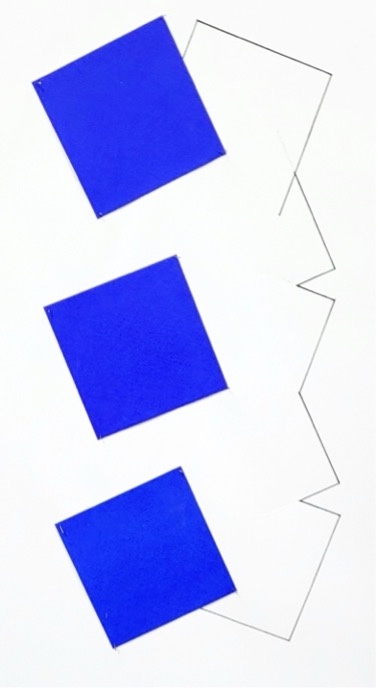
In Mehdi Moutashar's work, this articulation is explicit. His work, rooted in geometric abstraction, dialogues with the Islamic aesthetic tradition without ever falling into illustration. Squares, angles, open or pivoting lines are not closed forms: they function as signs in the making. Sometimes evoking the structures of Kufic calligraphy or the logic of nuqta, his compositions construct an autonomous visual language. Geometry is not decorative here; it becomes abstract writing, a mental space structured by rhythm and repetition.
“For me, the only material is space (...) There is one term that matters to me: to construct. (...) to create an autonomous plastic space,” he says.
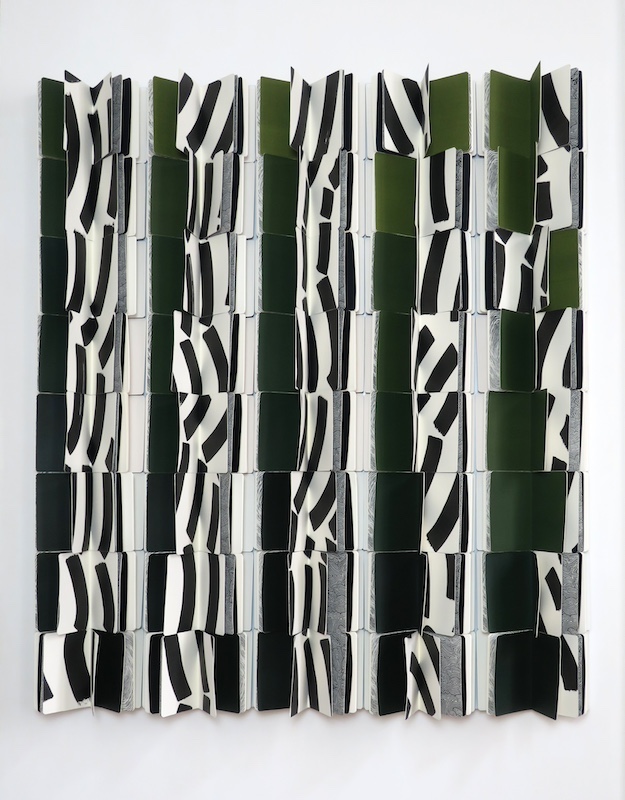
For Lina Ben Rejeb, the question of the sign is addressed through repetition. In Carnets, the motif is repeated until it produces a tiny variation. The gap becomes form. Writing slides into painting, then into matter. In Couverture muette, the old book, stripped of text, is preserved as a silent specimen: the act of preservation reinforces that of erasure. Between surface and volume, text and image, her work questions the memory of the sign and its transformation.
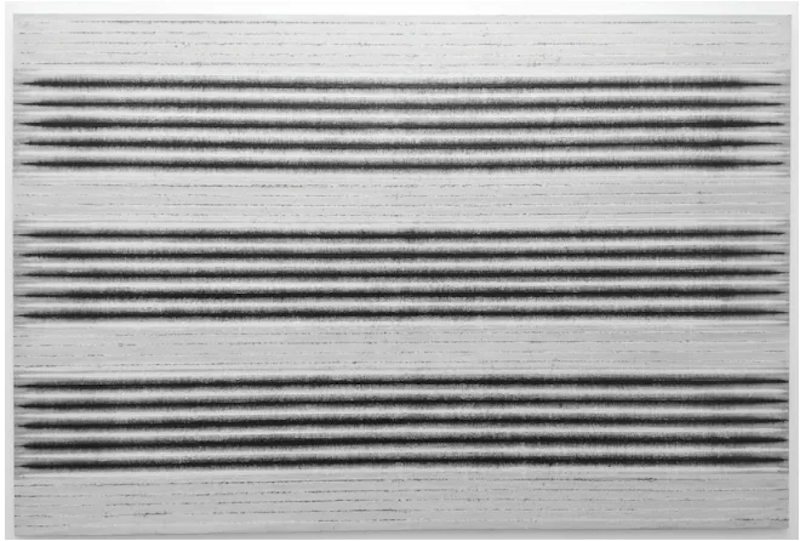
Yazid Oulab's work goes back to the very origin of inscription. Fascinated by cuneiform writing, literally “nail writing,” he establishes a link between tool and language. The nail, the trowel, the brush become matrices of the sign. In Infini, the metal wire traces a continuous, almost breathing line in space. The repeated streaks on his canvases densify the surface until a diffuse presence emerges. Writing becomes tension, transmission, circulation between manual gesture and thought.
“From the West, I inherited form; from the East, I inherited the word,” he summarizes.
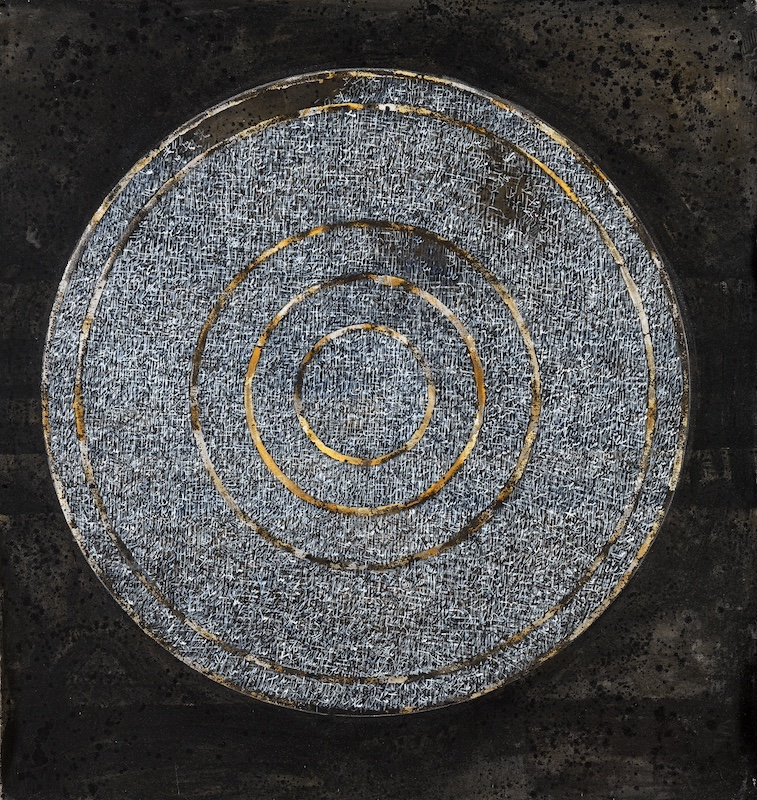
Finally, Nasser Al Aswadi transforms letters into architecture. Nourished by his experience between Yemen and France, he intertwines words until their legibility is blurred. The terms he chooses, Salam, Tolerance, Love, are densified, superimposed, almost compacted, to form vibrant surfaces where legibility dissolves into structure. His training as an architect is evident in the rigor of his compositions: writing becomes spatial construction, translating both turmoil and resistance.
Through these four approaches, Dialogues shows that writing is neither a simple motif nor a fixed heritage. It constitutes a field of plastic experimentation where modern abstraction and ornamental traditions, geometric rigor and spirituality, cultural memory and universal language meet.
The letter becomes form.
Form becomes space.
Space becomes a place for dialogue.
Artists:
Lina Ben Rejeb: born in 1985 in Kelibia (Tunisia). Lives and works in Paris.
Mehdi Moutashar: born in 1943 in Hilla (Iraq). Lives and works in Arles.
Yazid Oulab: born in 1958 in Constantine (Algeria). Lives and works in Marseille.
Nasser Al Aswadi: born in 1978 in Al-Hujr (Yemen). Lives and works between Marseille and Sanaa.
Their practices explore the same field of study: that in which writing becomes form, where the sign detaches itself from language to enter the realm of abstraction. At the crossroads of ornamentation, geometry, and calligraphy, their works are part of a long history: that of a dialogue between Islamic visual traditions and Western modernity.
Since the 20th century, many artists have explored the capacity of the calligraphic sign to join the quest for abstraction: reduction of form, autonomy of the line, primacy of rhythm, tension between surface and space. Writing, stripped of its literal function, becomes a plastic structure.
This encounter is neither quotation nor decoration. It is based on common concerns: how to organize the surface? How to inscribe movement in fixity? How to make the sign an autonomous space? Geometry, the founding principle of Islamic ornamentation, joins Western abstraction here in the same search for balance, rhythm, and infinity.
Thus a bridge is formed between East and West, outlining a shared terrain where visual language tends towards the universal.
In Mehdi Moutashar's work, this articulation is explicit. His work, rooted in geometric abstraction, dialogues with the Islamic aesthetic tradition without ever falling into illustration. Squares, angles, open or pivoting lines are not closed forms: they function as signs in the making. Sometimes evoking the structures of Kufic calligraphy or the logic of nuqta, his compositions construct an autonomous visual language. Geometry is not decorative here; it becomes abstract writing, a mental space structured by rhythm and repetition.
“For me, the only material is space (...) There is one term that matters to me: to construct. (...) to create an autonomous plastic space,” he says.
For Lina Ben Rejeb, the question of the sign is addressed through repetition. In Carnets, the motif is repeated until it produces a tiny variation. The gap becomes form. Writing slides into painting, then into matter. In Couverture muette, the old book, stripped of text, is preserved as a silent specimen: the act of preservation reinforces that of erasure. Between surface and volume, text and image, her work questions the memory of the sign and its transformation.
Yazid Oulab's work goes back to the very origin of inscription. Fascinated by cuneiform writing, literally “nail writing,” he establishes a link between tool and language. The nail, the trowel, the brush become matrices of the sign. In Infini, the metal wire traces a continuous, almost breathing line in space. The repeated streaks on his canvases densify the surface until a diffuse presence emerges. Writing becomes tension, transmission, circulation between manual gesture and thought.
“From the West, I inherited form; from the East, I inherited the word,” he summarizes.
Finally, Nasser Al Aswadi transforms letters into architecture. Nourished by his experience between Yemen and France, he intertwines words until their legibility is blurred. The terms he chooses, Salam, Tolerance, Love, are densified, superimposed, almost compacted, to form vibrant surfaces where legibility dissolves into structure. His training as an architect is evident in the rigor of his compositions: writing becomes spatial construction, translating both turmoil and resistance.
Through these four approaches, Dialogues shows that writing is neither a simple motif nor a fixed heritage. It constitutes a field of plastic experimentation where modern abstraction and ornamental traditions, geometric rigor and spirituality, cultural memory and universal language meet.
The letter becomes form.
Form becomes space.
Space becomes a place for dialogue.
Artists:
Lina Ben Rejeb: born in 1985 in Kelibia (Tunisia). Lives and works in Paris.
Mehdi Moutashar: born in 1943 in Hilla (Iraq). Lives and works in Arles.
Yazid Oulab: born in 1958 in Constantine (Algeria). Lives and works in Marseille.
Nasser Al Aswadi: born in 1978 in Al-Hujr (Yemen). Lives and works between Marseille and Sanaa.
When
14/03/2026 - 03/05/2026